Rome (Latin: Rōma),is the capital of Italy and its history spans 28 centuries. While Roman mythology dates the founding of Rome at around 753 BC, the site has been inhabited for much longer, making it one of the oldest continuously occupied sites in Europe. The city’s early population originated from a mix of Latins, Etruscans, and Sabines. Eventually, the city successively became the capital of the Roman Kingdom, the Roman Republic and the Roman Empire, and is regarded as the birthplace of Western civilisation and by some as the first ever metropolis. It was first called The Eternal City (Latin: Urbs Aeterna) by the Roman poet Tibullus in the 1st century BC, and the expression was also taken up by Ovid, Virgil, and Livy. Rome is also called the “Caput Mundi” (Capital of the World). The origin of the city’s name is thought to be that of the reputed founder and first ruler, the legendary Romulus. It is said that Romulus and his twin brother Remus, apparent sons of the god Mars and descendants of the Trojan hero Aeneas, were suckled by a she-wolf after being abandoned, then decided to build a city. The brothers argued, Romulus killed Remus, and then named the city Rome after himself.
Ancient Rome grew from a small town on central Italy’s Tiber River into an empire that at its peak encompassed most of continental Europe, Britain, much of western Asia, northern Africa and the Mediterranean islands. Among the many legacies of Roman dominance are the widespread use of the Romance languages (Italian, French, Spanish, Portuguese and Romanian) derived from Latin, the modern Western alphabet and calendar and the emergence of Christianity as a major world religion. After 450 years as a republic, Rome became an empire in the wake of Julius Caesar’s rise and fall in the first century B.C. The long and triumphant reign of its first emperor, Augustus, began a golden age of peace and prosperity.
Rome eventually collapsed under the weight of its own bloated empire and the incompetence of its emperors, losing its provinces one by one. Attila and his brutal Huns invaded Gaul and Italy around 450, further shaking the foundations of the empire. In September 476, a Germanic prince named Odovacar won control of the Roman army in Italy. After deposing the last western emperor, Romulus Augustus, Odovacar’s troops proclaimed him king of Italy, bringing an ignoble end to the long, tumultuous history of ancient Rome.
● June 21, 1529 – Catherine of Aragon’s famous speach at Blackfriars.
↳ Following King Henry’s declarations, Queen Catherine walked over to her hasband and threw hersef on her knees demostrating a posture of submission, to speak directly to him. The Speech was recorded by George Cavendish:
“Sir, I beseech you for all the loves there hath been between us, and for the love of God, let me have justice and right, take of me some pity and compassion, for I am a poor woman and a stranger born out of your dominions. I have here no assured friend, and much less indifferent counsel. I flee to you as to the head of justice within your realm. Alas! Sir, wherein have I offended you, or what occasion of displeasure have I designed against your will and pleasure? Intending (as I perceive) to put me from you, I take God and all the world to witness that I have been to you a true, humble, and obedient wife, ever conformable to your will and pleasure, that never said or did anything to the contrary thereof, being always well pleased and contented with all things wherein ye had any delight or dalliance, whether it were in little or much. I never grudged in word or countenance nor showed a visage or spark of discontentment. I loved all those whom ye loved only for your sake, whether I had cause or no and whether they were my friends or my enemies. This twenty years have I been your true wife, or more, and by me ye have had divers children, although it hath pleased God to call them out of the world, which has been no fault of mine.And when ye had me at the first, I take God to be my judge, I was a true maid without touch of man; and whether it be true or no, I put it to your conscience. If there by any just cause by the law that ye can allege against me, either of dishonesty or any other impediment to banish and put me from you, I am well content to depart, to my great shame and disparagement; and if there be none, then here I most lowly beseech you let me remain in my former estate and receive justice at your princely hands. The king your father was in the time of his reign of such estimation through the world for his excellent wisdom, that he was accounted and called of all men the second Solomon; and my father Ferdinand, King of Spain, who was esteemed to be one of the wittiest princes that reigned in Spain many years before, were both wise and excellent kings in wisdom and princely behavior. It is not therefore to be doubted but that they elected and gathered as wise counselors about them as to their high discretions were thought meet. Also, as me-seemeth, they had in their days as wise, well-learned men, and men of good judgment as be at this present in both realms, who thought then the marriage between you and me good and lawful. Therefore is it a wonder to me to hear what new inventions are now invented against me, that never intended but honesty. And cause me to stand to the order and judgment of this new court, wherein ye may do me much wrong if ye intend any kind of cruelty; for ye may condemn me for lack of sufficient answer, having no indifferent counsel but such as be assigned me, with whose wisdom and learning I am not acquainted. Ye must consider that they cannot be indifferent counselors for my part which be your subjects, and taken out of your own council before, wherein they be made privy, and dare not for your displeasure, disobey your will and intent, being once made privy thereto. Therefore, I most humbly require you, in the way of charity and for the love of God, who is the just judge, to spare the extremity of this new court until I may be advertised what way and order my friends in Spain will advise me to take. And if ye will not extend to me so much indifferent favor, your pleasure then be fulfilled, and to God I commit my case.”
My Favorite Ladies of History➵ Cleopatra VII Philopator (the final ruler of the Ptolmetic empire of Egypt before it fell under Roman rule) 69 – 30 BC
“Among the most famous women to have lived, Cleopatra VII ruled Egypt for twenty-two years. She lost a kingdom once, regained it, nearly lost it again, amassed an empire, lost it all. A goddess as a child, a queen at eighteen, a celebrity soon thereafter, she was an object of speculation and veneration, gossip and legend, even in her own time. At the height of her power she controlled virtually the entire eastern Mediterranean coast, the last great kingdom of any Egyptian ruler. For a fleeting moment she held the fate of the Western world in her hands.” – Cleopatra : A Life by Stacy Schiff
may 19, 1536 | the execution of anne boleyn, queen consort of england and second wife of king henry viii
For her final public appearance, Anne dressed carefully in a gown of grey damask edged with fur. A gabled hood, under which her long hair was tucked, framed her face. Determined to die boldly, Anne stepped onto the scaffold and addressed the crowd with a smiling countenance. The officials drew in their breath. Would the queen declare herself a good woman in her last moments and make mockery of the king’s justice?
To their relief, there were no surprises. Wanting to make a good end, and perhaps to protect her family from any royal reprisals, Anne made no accusation or criticism. But she admitted no guilt either. Following her brother’s example, Anne merely submitted herself to the law and prayed for the King, asking the crowd to do likewise for her. Anne climbed the scaffold steps with Kingston’s assistance and then addressed the waiting crowd:
“Good Christian people, I am come hither to die, for according to the law, and by the law I am judged to die, and therefore I will speak nothing against it. I am come hither to accuse no man, nor to speak anything of that, whereof I am accused and condemned to die, but I pray God save the king and send him long to reign over you, for a gentler nor a more merciful prince was there never: and to me he was ever a good, a gentle and sovereign lord. And if any person will meddle of my cause, I require them to judge the best. And thus I take my leave of the world and of you all, and I heartily desire you all to pray for me. O Lord have mercy on me, to God I commend my soul”.
As Anne prayed, the executioner called out to his assistant to pass him his sword. When Anne moved her head to try and hear what the assistant was doing, the executioner came up unnoticed behind her and beheaded her with one stroke of his sword. With a single deft swing, it was done. Death was quick and painless as had been promised her. (source)
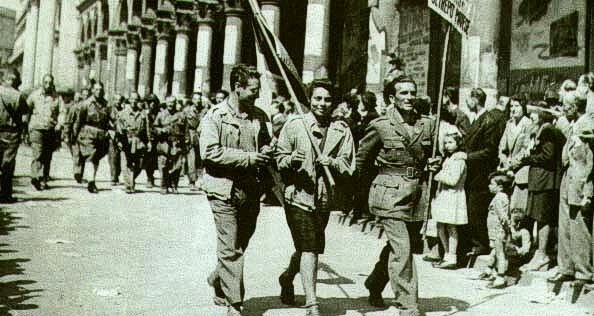
Italian History: 25 Aprile, Festa della Liberazione
Italy’s Liberation Day (Festa della liberazione), also known as the Anniversary of the Liberation (Anniversario della liberazione d’Italia), Anniversary of the Resistance (anniversario della Resistenza), or simply 25 April is a national Italian holiday commemorating the end of the Italian Civil War and the end of Nazi occupation of the country during World War II.
The date was chosen by convention, as it was the day of the year 1945 when the National Liberation Committee of Upper Italy (CLNAI) officially proclaimed the insurgency in a radio announcement, propounding the seizure of power by the CLNAI and proclaiming the death sentence for all fascist leaders. (It was also the day in which Milan and Turin were liberated)(x)

 persephone's corner