
- If the deceased has lived a good life, flowers would bloom on his grave; but if he has been evil, only weeds would grow.
- If several deaths occur in the same family, tie a black ribbon to everything left alive that enters the house, even dogs and chickens. This will protect against deaths spreading further.
- Never wear anything new to a funeral, especially shoes.
- You should always cover your mouth while yawning so your spirit doesn’t leave you and the devil never enters your body.
- It is bad luck to meet a funeral procession head on. If you see one approaching, turn around. If this is unavoidable, hold on to a button until the funeral cortege passes.
- Large drops of rain warn that there has just been a death.
- Stop the clock in a death room or you will have bad luck.
- To lock the door of your home after a funeral procession has left the house is bad luck.
- If rain falls on a funeral procession, the deceased will go to heaven.
- If you hear a clap of thunder following a burial it indicates that the soul of the departed has reached heaven.
- If you hear 3 knocks and no one is there, it usually means someone close to you has died. The superstitious call this the 3 knocks of death.
- If you leave something that belongs to you to the deceased, that means the person will come back to get you.
- If a firefly/lightning bug gets into your house someone will soon die.
- If you smell roses when none are around someone is going to die.
- If you don’t hold your breath while going by a graveyard you will not be buried.
- If you see yourself in a dream, your death will follow.
- If you see an owl in the daytime, there will be a death.
- If you dream about a birth, someone you know will die.
- If it rains in an open grave then someone in the family will die within the year.
- If a bird pecks on your window or crashes into one that there has been a death.
- If a sparrow lands on a piano, someone in the home will die.
- If a picture falls off the wall, there will be a death of someone you know.
- If you spill salt, throw a pinch of the split salt over your shoulder to prevent death.
- Never speak ill of the dead because they will come back to haunt you or you will suffer misfortune.
- Two deaths in the family means that a third is sure to follow.
- The cry of a curlew or the hoot of an owl foretells a death.
- A single snowdrop growing in the garden foretells a death.
- Having only red and white flowers together in a vase (especially in hospital) means a death will soon follow.
- Dropping an umbrella on the floor or opening one in the house means that there will be a murder in the house.
- A diamond-shaped fold in clean linen portends death.
- A dog howling at night when someone in the house is sick is a bad omen. It can be reversed by reaching under the bed and turning over a shoe.
Tag: history














“Even though Lorenzo was officially engaged to Clarice [Orsini], it was rumored, not without foundation, that he had organized the tournament in honor of his “platonic love” Lucrezia Donati, wife of Niccolò Ardinghelli. Following the medieval tradition of courtly love, young of Lorenzo’s and Giuliano’s rank were entitled to express their platonic interest in a lady, even if she were married. In fact, the relationship between Lorenzo and Lucrezia Donati was of long standing. As early as 1465, Alessandra Macinghi Strozzi had commented on the romance in a letter to her son Filippo in Naples. She wrote that, while Niccolò Ardinghelli was abroad, is wife was enjoying life in Florence. Lucrezia Donati, Alessandra says, had ordered a new livrea (a dress in her particular colors) adorned with enormous pearls, to wear to a ball organized by Lorenzo in her honor in the papal hall of Santa Maria Novella. Lorenzo and his companions wore outfits embroidered with pearls that bore Lucrezia’s colors.” – Maria Grazia Pernis, Laurie Adams – Lucrezia Tornabuoni De’ Medici and the Medici Family in the Fifteenth Century



Some sense of the shock Lorenzo felt at the death of his beloved brother can be gleaned by an uncharacteristic five-day gap in his correspondence. The heading over two blank pages in his secretary’s ledger reads, “Here and on the following page must be recorded the letters written about the tumult, when Giuliano de’ Medici was killed in Santa Reparata, may God have mercy on his soul.” The fact that they remained empty speaks volumes about Lorenzo’s state of mind. – Miles J. Unger









history week meme | day four: one location
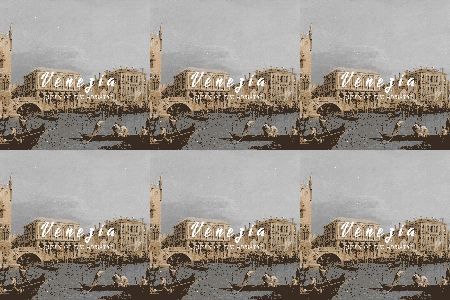
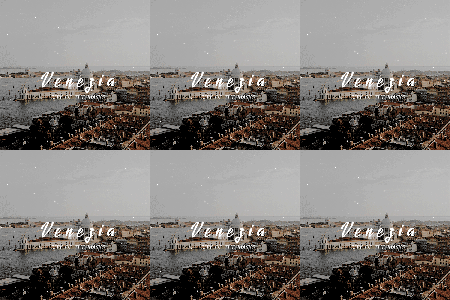
Venice is a city in northeastern Italy and the capital of the Veneto region. It is situated across a group of 118 small islands that are separated by canals and linked by over 400 bridges. The islands are located in the shallow Venetian Lagoon, an enclosed bay that lies between the mouths of the Po and the Piave rivers. Parts of Venice are renowned for the beauty of their settings, their architecture, and artwork. The name is derived from the ancient Veneti people who inhabited the region by the 10th century BCE. The city was historically the capital of the Republic of Venice. Venice has been known as the “La Dominante”, “Serenissima”, “Queen of the Adriatic”, “City of Water”, “City of Masks”, “City of Bridges”, “The Floating City”, and “City of Canals.”
The Republic of Venice was a major financial and maritime power during the Middle Ages and Renaissance, and a staging area for the Crusades and the Battle of Lepanto, as well as a very important center of commerce (especially silk, grain, and spice) and art in the 13th century up to the end of the 17th century. The city-state of Venice is considered to have been the first real international financial center which gradually emerged from the 9th century to its peak in the 14th century. This made Venice a wealthy city throughout most of its history.
It is also known for its several important artistic movements, especially the Renaissance period. After the Napoleonic Wars and the Congress of Vienna, the Republic was annexed by the Austrian Empire, until it became part of the Kingdom of Italy in 1866, following a referendum held as a result of the Third Italian War of Independence.




history week meme | day six: one art/literary movement or one piece of art/literature
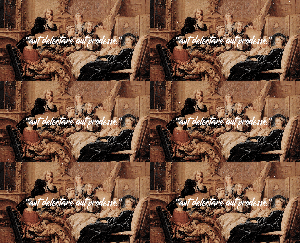
A salon (in french ‘Salon Littéraire’) is a gathering of people under the roof of an inspiring host, held partly to amuse one another and partly to refine the taste and increase the knowledge of the participants through conversation. The salon was an Italian invention of the 16th century, which flourished in France throughout the 17th and 18th centuries, under the influence of the Lumières (though they were carried on until as recently as the 1940s in urban settings.) These gatherings were important places for the exchange of ideas and often consciously followed Horace’s definition of the aims of poetry, “either to please or to educate” (Latin: aut delectare aut prodesse). They played a big part in the wake of the Age of the Enlightenment.
During the 18th century, women were the center of life in the salon and carried very important roles as regulators. They could select their guests and decide the subjects of their meetings. These subjects could be social, literary, or political topics of the time. They also served as mediators by directing the discussion. The period in which salons were dominant has been labeled the ‘age of conversation’ and The salonnières were expected, ideally, to run and moderate the conversations.



history week meme | day two: one
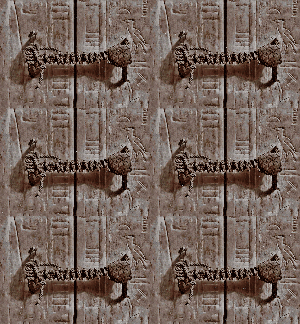
invention/discoveryIn 1917, Howard Carter, a british archeologist already experienced with excavations of tombs in Egypt, and Lord Carnavon, english peer and aristocrat, began excavating in earnest in the Valley of the Kings. Both wanted to make a great discovery, and Carter stated that there were several pieces of evidence – a faience cup, a piece of gold foil, and a cache of funerary items which all bore the name of Tutankhamun – already found that convinced him that the tomb of King Tut had not yet been found. Carter also believed that the locations of these items pointed to a specific area where they might find King Tutankhamun’s tomb. But after five years of unfruitful excavation, Lord Carnavon was ready to call a stop on the searches. After a discussion with Carter, Carnarvon relented and agreed to one last season.
By November 1, 1922, Carter began his final season working in the Valley of the Kings by having his workers expose the workmen’s huts at the base of the tomb of Rameses VI. After exposing and documenting the huts, Carter and his workmen began to excavate the ground beneath them.
By the fourth day of work, they had found something – a step that had been cut into the rock. Work feverishly continued on the afternoon of November 4th through the following morning. By late afternoon on November 5th, 12 stairs were revealed; and in front of them, stood the upper portion of a blocked entrance. Carter searched the plastered door for a name but of the seals that could be read, he found only the impressions of the royal necropolis. Carter ordered the staircase to be refilled, and sent a telegram to Carnarvon, who arrived two-and-a-half weeks later on 23 November. On the morning of November 25th, the sealed doorway was removed, and a passageway emerged from the darkness. The next morning, the door to the Antechamber came down, and revealed a part of the great golden treasure of King Tut. The coffin and the rest of the burial treasure was found and documented several months laters.
This discovery is still regarded as one (if not the) most incredible that have been made in the Valley of Kings, and the most popular in the world.






historical figures → cleopatra vii
“Among the most famous women to have lived, Cleopatra VII ruled for twenty-two years. She lost a kingdom once, regained it, nearly lost it again, amassed an empire, lost it all. A goddess as a child, a queen at eighteen, a celebrity soon thereafter, she was an object of speculation and veneration, gossip and legend, even in her own time. Like all lives that lend themselves to poetry, Cleopatra’s was one of dislocations and disappointments. She grew up amid unsurpassed luxury, to inherit a kingdom in decline. The Ptolemies were in fact Macedonian Greek, which makes Cleopatra approximately as Egyptian as Elizabeth Taylor. Thirteen hundred year separate Cleopatra from Nefertiti. The pyramids already sported graffiti. The Sphinx had undergone a major restoration, a thousand years earlier. And the glory of the once great Ptolemaic Empire had dimmed. Cleopatra’s was an era of outsize, intriguing personalities. At its end the greatest actors fo the age exist abruptly. A world comes crashing down after them.” Insp.
 persephone's corner