
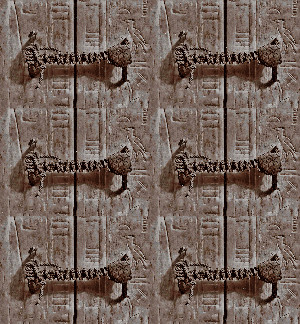

In 1917, Howard Carter, a british archeologist already experienced with excavations of tombs in Egypt, and Lord Carnavon, english peer and aristocrat, began excavating in earnest in the Valley of the Kings. Both wanted to make a great discovery, and Carter stated that there were several pieces of evidence – a faience cup, a piece of gold foil, and a cache of funerary items which all bore the name of Tutankhamun – already found that convinced him that the tomb of King Tut had not yet been found. Carter also believed that the locations of these items pointed to a specific area where they might find King Tutankhamun’s tomb. But after five years of unfruitful excavation, Lord Carnavon was ready to call a stop on the searches. After a discussion with Carter, Carnarvon relented and agreed to one last season.
By November 1, 1922, Carter began his final season working in the Valley of the Kings by having his workers expose the workmen’s huts at the base of the tomb of Rameses VI. After exposing and documenting the huts, Carter and his workmen began to excavate the ground beneath them.
By the fourth day of work, they had found something – a step that had been cut into the rock. Work feverishly continued on the afternoon of November 4th through the following morning. By late afternoon on November 5th, 12 stairs were revealed; and in front of them, stood the upper portion of a blocked entrance. Carter searched the plastered door for a name but of the seals that could be read, he found only the impressions of the royal necropolis. Carter ordered the staircase to be refilled, and sent a telegram to Carnarvon, who arrived two-and-a-half weeks later on 23 November. On the morning of November 25th, the sealed doorway was removed, and a passageway emerged from the darkness. The next morning, the door to the Antechamber came down, and revealed a part of the great golden treasure of King Tut. The coffin and the rest of the burial treasure was found and documented several months laters.
This discovery is still regarded as one (if not the) most incredible that have been made in the Valley of Kings, and the most popular in the world.

“Among the most famous women to have lived, Cleopatra VII ruled for twenty-two years. She lost a kingdom once, regained it, nearly lost it again, amassed an empire, lost it all. A goddess as a child, a queen at eighteen, a celebrity soon thereafter, she was an object of speculation and veneration, gossip and legend, even in her own time. Like all lives that lend themselves to poetry, Cleopatra’s was one of dislocations and disappointments. She grew up amid unsurpassed luxury, to inherit a kingdom in decline. The Ptolemies were in fact Macedonian Greek, which makes Cleopatra approximately as Egyptian as Elizabeth Taylor. Thirteen hundred year separate Cleopatra from Nefertiti. The pyramids already sported graffiti. The Sphinx had undergone a major restoration, a thousand years earlier. And the glory of the once great Ptolemaic Empire had dimmed. Cleopatra’s was an era of outsize, intriguing personalities. At its end the greatest actors fo the age exist abruptly. A world comes crashing down after them.” Insp.
Listen my dudes Ancient Egypt existed for a really fuckass long time. Literally just Pharaonic civilization lasted 3,000 years. That’s not even including predynastic civilization and Roman rule. If you lump that in you’re looking at more like… 5,000 years.
Like. If you want a comparison of how long that is: THE YEAR IS CURRENTLY 2018. TWO THOUSAND. TWO-THIRDS OF ANCIENT EGYPTIAN PHARAONIC CIVILIZATION HAVE HAPPENED SINCE THE ‘BIRTH OF JESUS CHRIST’
We comparatively just entered the Third Intermediate Period. The Greeks will not take over for another 700~ years. Cleopatra will not be born until the year 2931.
It’s a really long time guys.
Anyway look. Listen. I sat my ass down and wrote out a timeline of “when shit happened if you started at 1AD” because I know backwards numbers are hard to process but here’s an abridged version.
If the first Egyptian Pharaoh came to power in 1AD then…
300: step pyramid built
450: Great Pyramid at Giza built
815: Pepi II dies and civil war breaks out
950: Egypt re-unified
1350: Middle Kingdom ends
1450: New Kingdom begins
1520: Hatshepsut is on the throne
1650: Ahkenaten switches to monotheistic religion and builds a new city
1680: Tutankhamun dies
1720: Ramesses II ‘the great’ ascends to the throne
1740: World’s first peace treaty signed 1790: Ramesses II dies leaving way too many children
1920: Egypt breaks into 2 states again
And now we get to ~~~~the future~~~~. If we started at 1AD all of this stuff hasn’t happened yet
2050: Briefly re-united as a single state
2180: Civil war 2250: Nubian kings take over
2335: Assyrian conquest
2665: Alexander the Great conquers Egypt
2930: Cleopatra VII born
2970: Cleopatra VII dies. Egypt falls to Rome. Fin.
And that’s just starting with the Pharaohs. If you wanted to start with Predynastic Egypt, you can go ahead and ADD ONE THOUSAND YEARS to all of those dates
I hate that this is still getting notes but that it’s getting notes *without the timeline addition* like c’mon, man. I had to do MATHS for this. I DID MATHS FOR YOU PEOPLE AND ALL I GOT WAS A BUNCH OF RACISTS
Ankhesenamun, meaning “Her Life is of Amun”, at aged thirteen, married her half-brother Tutankhamun, becoming queen of the Eighteenth Dynasty of Egypt. When the young Pharaoh died, he left Ankhe alone without an heir in her early twenties. She continued in the official capacity as queen of Egypt and played a major role in finding a successor. It’s not known where her body was placed upon her death, no funerary objects with her name are known to exist; this leaves the chance that her tomb is still somewhere out there, waiting to be found.
Egypt is a country in North Africa, on the Mediterranean Sea, and is home to one of the oldest civilizations on earth. The name ‘Egypt’ comes from the Greek Aegyptos which was the Greek pronunciation of the ancient Egyptian name ‘Hwt-Ka-Ptah’ (“Mansion of the Spirit of Ptah”), originally the name of the city of Memphis. To the ancient Egyptians themselves, their country was simply known as Kemet which means ‘Black Land’ so named for the rich, dark soil along the Nile River where the first settlements began. Later, the country was known as Misr which means ‘country’, a name still in use by Egyptians for their nation in the present day. Egypt thrived for thousands of years (from c. 8000 BCE to c. 30 BCE) as an independent nation whose culture was famous for great cultural advances in every area of human knowledge, from the arts to science to technology and religion. The great monuments which ancient Egypt is still celebrated for reflect the depth and grandeur of Egyptian culture which influenced so many ancient civilizations, among them Greece and Rome.
One of the reasons for the enduring popularity of Egyptian culture is its emphasis on the grandeur of the human experience. Their great monuments, tombs, temples, and art work all celebrate life and stand as reminders of what once was and what human beings, at their best, are capable of achieving. Nowadays, it is still regarded as one of the greatest civilisations of human history.
During the nineteenth Dynasty a queen by the name of Nefertari ( ? – ca 1255 BCE ) was in power with Ramesses the Great. She was one of many wives, but continued to remain one of his favorites. Her birth parents remain a mystery, but it’s determined she is of royal heritage. It is however known that she had a brother by the name of Amenmose who was the mayor of Thebes during her rule as queen. She had two sons, Amonhirwonmef, Prehirwonmef and two daughters named Merytamon, and Mertatum.
Looking at all the monuments constructed it is pretty evident she was of high importance. She must have played an important role in her time. Most depictions of the queen stand with Ramesses II, which might mean she might have had a major political influence on Egypt. Ramesses II also dedicated a temple to her called Abu Simbel. This temple is located south of Aswan near the second Cataract of the Nile. This temple was designed with four large statues of Ramesses II with several small figures at his side. The temple was dedicated to the goddess Hathor and Queen Nefertari.
Nefertari was not the only Queen present during the rule of Ramesses II. In fact, Ramesses had a harem filled with many queens. His children were estimated at one hundred or more. Ramesses refers to her as the most beautiful one though.
Her disappearance remains a mystery. Experts aren’t sure if she died, or just remained part of the great harem. Her tomb has been found and it remains a precious treasure of Egypt. Her tomb is said to be one of the more extraordinary tombs found to date. It’s located in The Valley of the Queens. ( for @anastasiasromanovs ❤ )
My Favorite Ladies of History➵ Cleopatra VII Philopator (the final ruler of the Ptolmetic empire of Egypt before it fell under Roman rule) 69 – 30 BC
“Among the most famous women to have lived, Cleopatra VII ruled Egypt for twenty-two years. She lost a kingdom once, regained it, nearly lost it again, amassed an empire, lost it all. A goddess as a child, a queen at eighteen, a celebrity soon thereafter, she was an object of speculation and veneration, gossip and legend, even in her own time. At the height of her power she controlled virtually the entire eastern Mediterranean coast, the last great kingdom of any Egyptian ruler. For a fleeting moment she held the fate of the Western world in her hands.” – Cleopatra : A Life by Stacy Schiff
Queen Hatshepsut of Ancient Egypt. She has a lovely smile for someone who’s been dead for thousands of years.
she wasn’t a queen. she was a pharaoh and wanted to be referred to as such. she even had her statues modeled after the male pharaoh’s statues to state her dominance and authority. she was actually one of the most successful pharaohs in all of ancient egyptian history and she reigned longer than any other woman in power in egypt.
damn no wonder she died and smiled for a trillion years afterwards
The fact that we know about her is marvelous.
the next Pharaoh after her Tuthmosis III tried to erase Hatshepsut out of history ,chiseled her name off her monuments ,covered the text on her obelisks with stone,knocked down and defaced her statues .
she was even left off the list of pharaohs ..talk about some patriarchy bullshit
her name was lost for a couple of millennia, her body was found in a unmarked grave in early twentieth century
sad part is in Egyptian belief is if your are forgotten in the living world you don’t exist in the afterlife,so he was trying to kill her even in death
My best friend throwing down some herstory. A+ commentary
She wore a fake beard, you guys. She was the fucking boss.
If we remember her now does that save her from an awful afterlife?
I’m just picturing the Kemetic afterlife. All the Pharaohs are hanging out in some kind of swanky club, drinking and congratulating each other on being bros.
The doors slam open and Hatshepsut strides in, glorious, robes swirling, rocking the fake beard and the insane amounts of wealth and power. “Miss me, bitches?”
Then she punches Tuthmosis III straight in the dick.
Reblog so Hatshepsut can dick punch tuthmosis in the afterlife.